
SEO (Search Engine Optimization) is the process of optimizing a website to improve its visibility in search engine results, attract more organic (non-paid) traffic, and help users find relevant content more easily. It involves improving content, website performance, technical structure, and authority to achieve higher rankings on search engines like Google.
Search Engine Optimization shapes how people find information, products, and services online. Every time someone types a question into Google or asks a voice assistant for help, SEO decides which websites show up first. If your website is not optimized, potential customers will never find you, no matter how good your product or service is. Search Engine Optimization has changed a lot over the past few years. Search engines now rely on artificial intelligence to understand content, match search intent, and generate AI Overviews directly on the results page. This means Search Engine Optimization is no longer just about ranking on page one. It is about becoming a trusted source that both search engines and AI systems choose to reference.
My name is Prabin Rai, and I work as an SEO expert helping businesses improve their organic visibility, attract qualified traffic, and convert visitors into customers. In this guide, I will walk you through everything you need to know about Search Engine Optimization, from the basics to advanced strategies, so you can build a website that performs well today and stays competitive as search continues to evolve.
What Is SEO?
Search Engine Optimization is the process of improving a website so it appears higher in organic, meaning unpaid, search results. Instead of paying for ads, Search Engine Optimization focuses on earning visibility through relevant content, technical performance, and trust signals that search engines value.
There is an important difference between organic and paid search. Paid search, such as Google Ads, gives you instant visibility but stops the moment you stop paying. Organic search takes longer to build, but once your pages rank well, they continue to bring traffic without ongoing ad spend. This is why SEO is considered one of the most cost effective long term marketing strategies available.
How Search Engines Work
To understand SEO, you need to understand how search engines actually operate. The process happens in three main stages.
Crawling is when search engines send automated bots, often called spiders, to discover pages across the internet. These bots follow links from page to page, collecting information about each one.
Indexing happens after crawling. The search engine stores and organizes the information it collected in a massive database called an index. If a page is not indexed, it cannot appear in search results, no matter how well it is written.
Ranking is the final stage. When someone searches for something, the search engine scans its index and ranks pages based on relevance, quality, and hundreds of other signals. Search intent plays a major role here, since search engines try to match results with what the user actually wants to accomplish, not just the words they typed.
Why SEO Is Important
Benefits of SEO

Investing in SEO delivers several long term advantages for businesses of any size.
- More organic traffic that does not depend on paid advertising budgets
- Better brand visibility across search results and related platforms
- Higher credibility, since users often trust organic listings more than ads
- Better return on investment compared to many paid channels
- Long term growth that compounds as your site builds authority over time
Unlike paid campaigns that stop generating results the moment you pause spending, a well optimized page can keep bringing visitors for months or years after it is published.
Who Needs Search Engine Optimization?
SEO is not limited to large corporations. It benefits almost any business or website that wants to be found online.
Small businesses use Search Engine Optimization (SEO) to compete with larger companies without needing a massive advertising budget. Similarly, local businesses rely on SEO to appear when nearby customers search for their products or services. Likewise, e-commerce stores depend on SEO to showcase their products to shoppers who are ready to buy. In addition, bloggers use SEO to grow their audience, increase organic traffic, and build authority in their niche. Finally, service-based websites use SEO to generate qualified leads and inquiries from people who are actively searching for their solutions.
Whatever type of website you run, SEO helps you reach people at the exact moment they are searching for what you offer.
Types of Search Engine Optimization
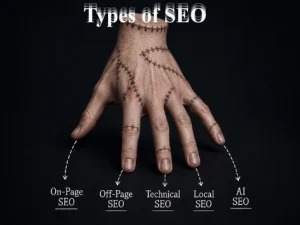
Search Engine Optimization is not a single technique. It is a combination of different strategies that work together. Understanding each type helps you build a complete optimization plan.
On-Page SEO
On-page SEO refers to everything you control directly on your website to help it rank better. First, it includes keyword research to understand what your audience is searching for. Next, well-crafted title tags and meta descriptions encourage users to click on your pages. Additionally, properly structured heading tags organize your content and improve readability. Similarly, clean URL structures make your pages easier for both users and search engines to understand. Furthermore, internal linking connects related pages and helps distribute authority across your website. In addition, optimized images with descriptive file names and alt text improve accessibility and image search visibility. Ultimately, high-quality content that genuinely answers the reader’s questions provides the best user experience and supports long-term SEO success.
Good on-page SEO makes it easier for both users and search engines to understand what a page is about and why it deserves to rank.
Technical SEO
Technical SEO focuses on the backend elements that help search engines crawl and index your site efficiently. Important areas include an XML sitemap that lists all your important pages, a robots.txt file that guides crawlers on what to access, canonical URLs that prevent duplicate content issues, schema markup that helps search engines understand your content in a structured way, strong Core Web Vitals scores that measure loading speed and interactivity, mobile optimization since most searches now happen on phones, and fast page speed across your entire site.
Without solid technical SEO, even the best written content can struggle to rank because search engines simply cannot crawl or understand it properly.
Off-Page SEO
Off-page SEO covers actions taken outside your own website that influence your rankings. The most important factor here is backlinks, which are links from other websites pointing to yours. Search engines treat backlinks as votes of confidence. Other elements include digital PR that earns media coverage and mentions, brand mentions across the web even without a direct link, strategic link building campaigns, and overall domain authority that builds up as more reputable sites reference your content.
Off-page SEO tells search engines that other trusted sources vouch for your website, which strengthens your credibility.
Local SEO
Local SEO helps businesses appear in searches from people nearby, especially in Google Maps results and the local pack. Key components include an optimized Google Business Profile, consistent local citations across directories, positive customer reviews, location specific keywords, and strong map pack rankings.
For any business with a physical location or a service area, local SEO is often the fastest way to generate walk-in customers or local leads.
AI SEO
AI SEO, sometimes called AI Search Optimization, is quickly becoming one of the most important areas of modern Search Engine Optimization. As AI Overviews and generative search results become common, websites need to optimize for how AI systems read and summarize content, not just how traditional search engines rank pages.
This involves entity Search Engine Optimization, which means clearly defining who you are and what your business represents, structured content that is easy for AI to parse and quote, and a strong E-E-A-T profile, which stands for experience, expertise, authoritativeness, and trustworthiness. Semantic SEO also plays a role here, since AI systems focus on meaning and context rather than just matching exact keywords.
Businesses that adapt early to AI SEO will have a significant advantage as more searches are answered directly within AI generated summaries.
Search Engine Optimization Ranking Factors
Search engines use hundreds of signals to decide how to rank a page, but some factors carry more weight than others.
Helpful content that genuinely answers the searcher’s question ranks better than content written purely to target keywords. Search intent alignment matters just as much, since a page must match what the user actually wants, whether that is information, a product, or a specific action. Content quality, including accuracy, depth, and originality, continues to be a core ranking signal.
Page experience, which includes how smoothly a page loads and functions, directly affects rankings. Mobile friendliness is essential since Google primarily uses mobile-first indexing. HTTPS security is now a baseline requirement rather than a bonus. Internal linking helps search engines understand your site structure and distribute authority across pages. Backlinks from relevant, trustworthy sites remain one of the strongest off-page signals. Finally, website speed affects both user experience and how search engines evaluate your site.
Search Engine Optimization Checklist
Use this checklist as a practical starting point whenever you are optimizing a website or launching new content.
- Complete keyword research before writing any content
- Analyze competitors ranking for your target keywords
- Run a full SEO audit of your existing site
- Fix technical issues found during the audit
- Write optimized titles that include your primary keyword
- Craft compelling meta descriptions for every page
- Add internal links between related pages
- Build external links from credible, relevant sources
- Implement structured data where appropriate
- Optimize all images with descriptive alt text
- Confirm the site is fully mobile friendly
- Monitor and improve Core Web Vitals scores
- Update older content regularly to keep it accurate
Following this checklist consistently helps you avoid the common gaps that quietly hold websites back from ranking well.
Keyword Research for Search Engine Optimization
Keyword research is the foundation of every successful SEO strategy. It starts with understanding search intent, meaning what the person actually wants when they type a specific query. Are they looking for information, comparing options, or ready to make a purchase?
Keyword difficulty tells you how hard it will be to rank for a particular term based on existing competition. Search volume shows how many people are searching for that keyword each month, helping you prioritize terms with real demand. Long-tail keywords, which are longer and more specific phrases, often convert better because they capture users further along in their decision making process.
Building topic clusters around a central theme, supported by dedicated content hubs, helps establish topical authority. This means creating one comprehensive pillar page, like this one, and linking it to multiple supporting articles that each cover a specific subtopic in depth.
Tools like Google Search Console and Google Analytics provide valuable first party data on how your site already performs. Ahrefs, Semrush, and Moz offer deeper competitive research, keyword suggestions, and backlink analysis to guide your strategy.
Essential SEO Tools

Having the right tools makes Search Engine Optimization far more manageable. Here are some of the most widely used platforms and what they are best for.
| Tool | Purpose |
|---|---|
| Google Search Console | Tracks search performance, indexing status, and technical issues |
| Google Analytics | Measures website traffic, user behavior, and conversions |
| Ahrefs | Analyzes backlinks and competitor SEO strategies |
| Semrush | Supports keyword research and competitive analysis |
| Screaming Frog | Runs detailed technical SEO audits |
| PageSpeed Insights | Measures page speed and Core Web Vitals performance |
You do not need every tool on this list to succeed. Start with Google Search Console and Google Analytics, since both are free, then add others as your needs grow.
Common SEO Mistakes
Many websites underperform not because they lack good products or services, but because of avoidable SEO mistakes. Watch out for these issues on your own site.
Keyword stuffing, or cramming keywords unnaturally into content, damages readability and can hurt rankings. Thin content that does not fully answer a question fails to satisfy search intent. Duplicate content confuses search engines about which version to rank. A slow website frustrates visitors and increases bounce rates. Missing schema markup means search engines miss opportunities to display rich results for your pages.
Poor internal linking leaves valuable pages isolated and harder to discover. A missing sitemap can delay or prevent proper indexing. As well as, Ignoring search intent leads to content that technically includes the right keywords but fails to meet what users actually need. Poor user experience, including confusing navigation or intrusive pop-ups, drives visitors away before they engage with your content.
SEO Trends
SEO continues to evolve, and staying current with emerging trends helps you maintain a competitive edge.
AI Search Optimization is reshaping how content needs to be structured for AI Overviews and generative search results. Generative AI tools are changing how people search, often skipping traditional search engines entirely in favor of conversational queries. Semantic search focuses on understanding meaning and context rather than exact keyword matches, rewarding content that thoroughly covers a topic.
Voice search continues to grow as more people use smart speakers and voice assistants, favoring natural, conversational phrasing. Entity Search Engine Optimization emphasizes clearly establishing who you are, what you offer, and how you connect to related topics and organizations. Zero-click searches, where users get their answer directly on the results page, make it more important to be the featured source even without a click. User experience and Core Web Vitals remain central to how search engines evaluate page quality.
Why Choose Prabin Rai as Your SEO Expert?
With years of hands-on experience across technical SEO, on-page and off-page optimization, and the emerging field of AI Search Optimization, I help businesses build a genuine, lasting presence in search results.
My approach covers local SEO strategies for businesses that depend on nearby customers. Additionally, I provide WordPress SEO for site owners who need platform-specific expertise. Furthermore, I conduct comprehensive Search Engine Optimization audits to uncover exactly what is holding a website back. In addition, I develop a content strategy that aligns with real search intent and user needs. Moreover, I provide transparent reporting so you always know what is happening and why. Most importantly, I focus on long-term, sustainable growth rather than short-lived tactics that lose effectiveness after a few months.
Looking to grow your website with proven SEO strategies? I’m Prabin Rai, an SEO expert helping businesses improve search visibility, organic traffic, and conversions through data-driven SEO solutions. Get in touch today for a personalized SEO strategy.
Frequently Asked Questions
What is SEO?
SEO stands for Search Engine Optimization. It is the practice of improving a website so it ranks higher in organic search results, increasing visibility and traffic without paying for ads.
How long does SEO take?
Most websites start seeing meaningful results within three to six months, though competitive industries can take longer. SEO is a long term strategy rather than an instant fix.
Is SEO worth it?
Yes. SEO delivers long lasting traffic and credibility that continues to pay off well after the initial work is done, making it one of the most cost effective marketing investments available.
What are the different types of SEO?
The main types include on-page SEO, technical SEO, off-page SEO, local SEO, and AI SEO. Each addresses a different part of how search engines evaluate and rank websites.
How much does SEO cost?
Costs vary widely depending on the scope of work, the competitiveness of your industry, and whether you hire a freelancer, consultant, or agency. Ongoing SEO typically works best as a ongoing monthly investment rather than a one-time project.
Can I do SEO myself?
Basic SEO practices, such as writing good titles and improving page speed, can be handled without much experience. More advanced technical and strategic work often benefits from professional guidance.
What is Technical SEO?
Technical SEO involves optimizing the backend of your website, including site speed, mobile friendliness, crawlability, and structured data, so search engines can access and understand your content properly.
What is Local SEO?
Local SEO helps businesses appear in search results for people searching nearby, primarily through an optimized Google Business Profile, local citations, and customer reviews.
What is AI SEO?
AI SEO focuses on optimizing content so it performs well within AI Overviews and generative search experiences, emphasizing clear structure, strong E-E-A-T signals, and semantic relevance.
What tools are best for Search Engine Optimization?
Google Search Console and Google Analytics are essential free tools. Ahrefs, Semrush, and Screaming Frog offer deeper insights for keyword research, backlink analysis, and technical audits.
How often should I update website content?
Reviewing and updating key pages every six to twelve months helps keep information accurate and signals to search engines that your content remains relevant.
How do backlinks help SEO?
Backlinks act as votes of confidence from other websites. When reputable sites link to your content, search engines view your site as more trustworthy and authoritative, which can improve rankings.
Contact
📞Phone: +977-9709085108
✉️Email: prabinrai@suryani.com.np